How to Instantly Disable or Update Links & QR Codes Without Reprinting
Every offline or long-running campaign eventually breaks.
- A landing page changes
- A product goes out of stock
- A form closes
- A campaign ends
- A link gets flagged
If your QR codes or short links are static, your only fix is expensive and slow:
Reprint everything.
This guide explains why static links fail operationally, how instant updates actually work, and how to design campaigns that can be fixed in seconds—not weeks.
The Hidden Risk of Static Links
Static links and QR codes embed the final destination directly.
That means:
- Once printed, they cannot be changed
- Errors persist everywhere
- Old links stay live forever
- Mistakes scale with distribution
The more you print, the more dangerous static links become.
Common Situations Where This Breaks Campaigns
Static links fail in predictable ways:
- Landing page URLs change
- Campaigns expire but links stay active
- Compliance pages need updates
- Incorrect URLs are printed
- Domains get flagged or blocked
In all cases, the result is the same: broken traffic and lost trust.
Why Reprinting Is the Worst Possible Fix
Reprinting sounds simple—until you count the cost:
- Design revisions
- Print delays
- Distribution logistics
- Wasted inventory
- Brand embarrassment
Most teams don’t reprint immediately.
They leave broken links live far longer than they should.
How Instant Updates Actually Work
Instant updates are not magic.
They’re architectural.
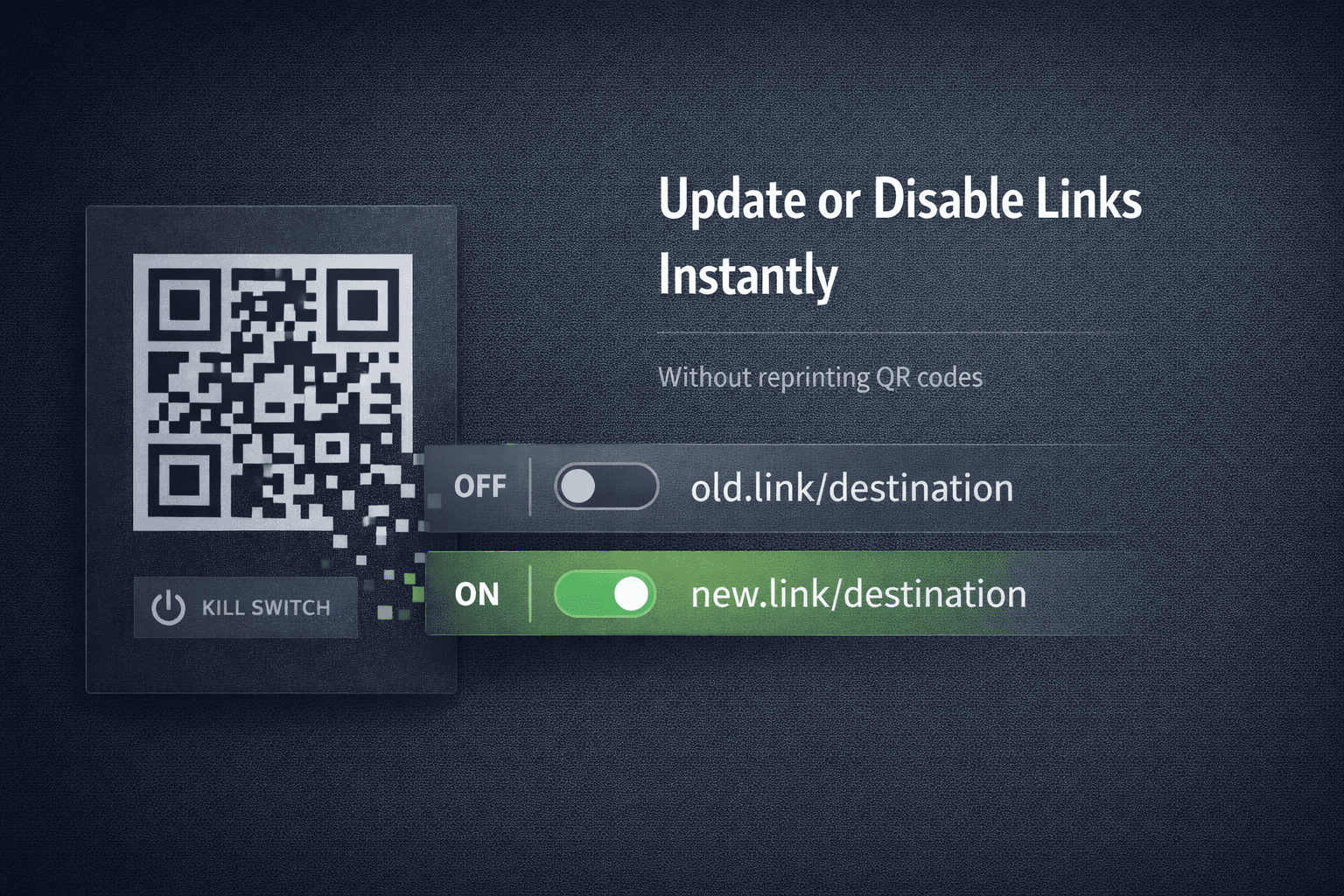
Instead of embedding the final URL, links and QR codes point to a controlled redirect layer.
That layer:
- Resolves to the destination dynamically
- Can be updated at any time
- Applies changes everywhere instantly
The QR code never changes.
Only the destination does.
The Kill Switch: When You Must Disable Links Immediately
Some situations require instant shutdown:
- Security incidents
- Compliance violations
- Incorrect promotions
- Malicious reports
- Campaign takedowns
Without a kill switch:
- Traffic continues flowing
- Damage accumulates
- Recovery gets harder
With one toggle, links should stop resolving—or redirect safely.
Static links can’t do this.
Dynamic links can.
Updating Links Without Breaking Analytics
A common fear is:
“If we change the destination, we lose tracking.”
That only happens with poor tooling.
A proper system:
- Preserves historical data
- Tracks changes by version
- Keeps analytics intact
- Shows performance before and after updates
Updating should not mean losing insight.
Where ZipZy Fits
ZipZy generates short links and QR codes that route through a controlled, dynamic redirect layer.
This allows you to:
- Update destinations instantly
- Disable links when needed
- Fix mistakes without reprinting
- Keep analytics intact across changes
- Maintain control long after distribution
The printed QR code never changes.
Your control does not expire.
A Simple Test to See If You’re at Risk
Answer this honestly:
If a printed QR code is wrong today, how fast can we fix it?
- Minutes → you’re safe
- Days → you’re exposed
- Never → you’re already leaking value
Speed of correction matters more than perfection.
Static links assume nothing will ever change.
That assumption is always wrong.
Campaigns evolve.
Mistakes happen.
Links get flagged.
If you can’t update or disable links instantly, your infrastructure is brittle.
Control isn’t a nice-to-have.
It’s operational safety.