How Security, Analytics, and Control Come Together in Modern Link Management
Most teams start with links as utilities.
They shorten URLs.
They generate QR codes.
They check click counts.
Then scale happens—and links quietly turn into infrastructure.
That’s when problems appear:
- Deliverability drops
- Analytics stop matching reality
- Campaigns break without warning
- Security incidents surface too late
- Control disappears once links are shared
Modern link management exists to solve this exact convergence of problems.
The Old Model: Links as Static Utilities
Traditional link tools treat links as one-time objects:
- Create once
- Share everywhere
- Hope nothing changes
This model assumes:
- Destinations stay stable
- Campaigns don’t evolve
- Abuse doesn’t happen
- Platforms remain neutral
All four assumptions are wrong.
At scale, links are living systems, not static assets.
Why Link Problems Always Appear Together
Security, analytics, and control are not separate concerns.
When one fails, the others follow.
Examples:
- Blocked links → broken analytics
- Shared domains → inherited security risk
- Static QR codes → no recovery or insight
- No access control → link abuse and leaks
- No monitoring → late detection of problems
Trying to fix these issues individually never works long-term.
Pillar 1: Security (Preventing Damage)
Security answers one question:
Can this link be trusted right now?
Modern link security requires:
- Domain ownership and isolation
- Clean, transparent redirects
- Ability to disable links instantly
- Protection against abuse and misuse
- Monitoring for behavioral changes
Security must happen before the destination loads—not after users complain.
Pillar 2: Analytics (Seeing Reality)
Analytics answers a different question:
What is actually happening when people interact with this link?
Modern link analytics go beyond clicks:
- Pre-landing behavior
- Delivery consistency across platforms
- Scan vs preview separation
- Traffic quality signals
- Campaign-level comparison
Without this visibility, teams optimize noise instead of outcomes.
Pillar 3: Control (Fixing Problems Fast)
Control answers the most important question:
How quickly can we correct mistakes?
Control means:
- Updating destinations without reprinting
- Disabling links when needed
- Applying expiry, passwords, and rules
- Preserving analytics through changes
- Maintaining authority after distribution
Static links offer none of this.
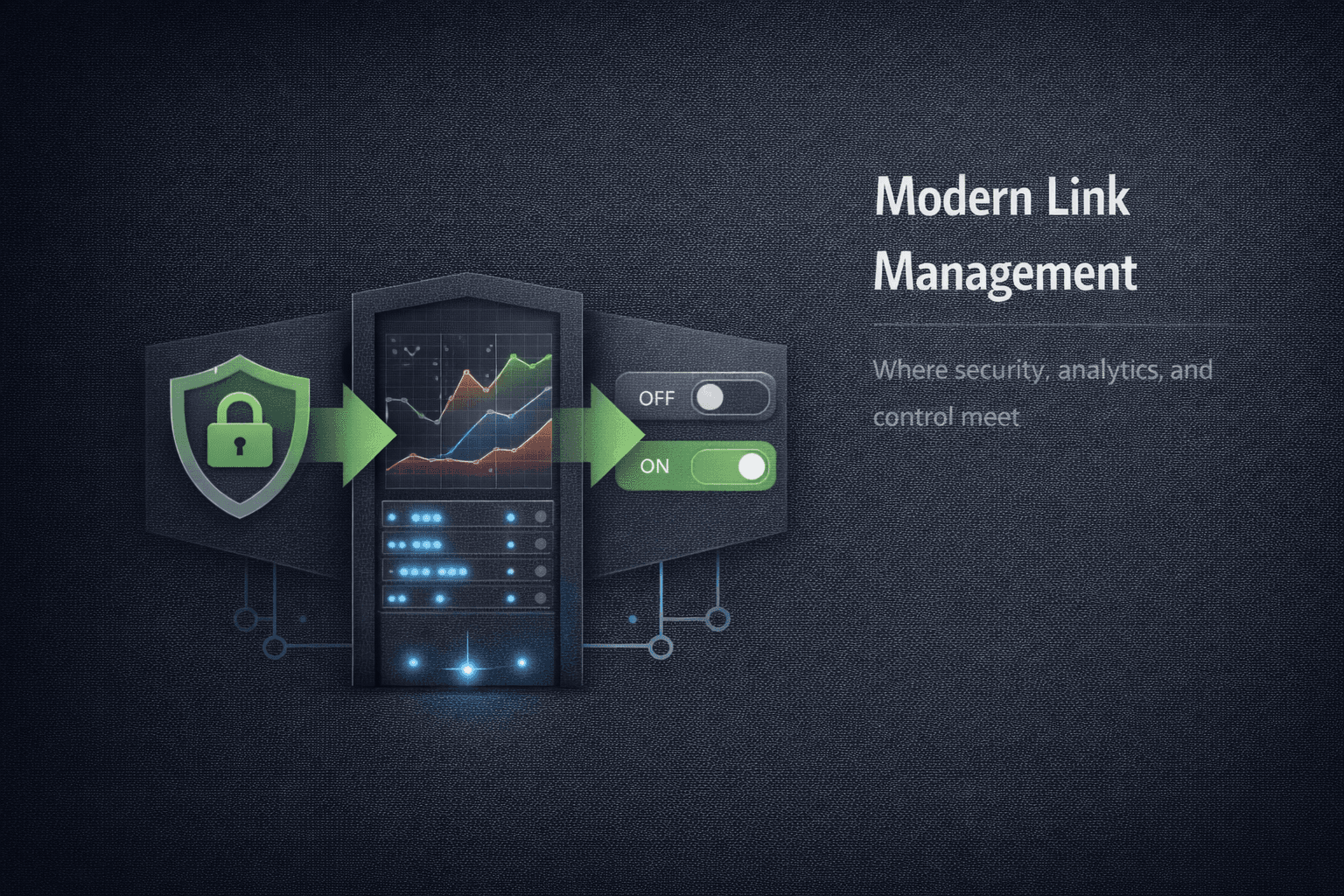
Why These Three Must Work Together
Security without analytics is blind.
Analytics without control is powerless.
Control without security creates risk.
Modern link management works only when:
- Security protects trust
- Analytics reveal behavior
- Control enables correction
This is why advanced teams stop thinking in terms of “shorteners” and start thinking in terms of link infrastructure.
Where ZipZy Fits
ZipZy is designed around this integrated model.
It treats links and QR codes as managed infrastructure, providing:
- Branded domains with isolated reputation
- Transparent, direct redirects
- Visibility into link behavior
- Control to update, disable, or protect links
- Consistent data across campaigns and time
The goal isn’t more features.
It’s fewer surprises.
The Maturity Shift Most Teams Miss
Teams usually evolve through stages:
- Creation — “We need a short link”
- Measurement — “How many clicks?”
- Reliability — “Why did this stop working?”
- Protection — “How do we prevent damage?”
- Infrastructure — “How do we manage this long-term?”
Modern link management starts at stage five.
A Final Reality Check
Ask yourself:
- Can we stop a bad link instantly?
- Can we update QR codes already printed?
- Can we trust our analytics numbers?
- Can we recover from a flagged domain?
- Can we control who accesses sensitive links?
If the answer to any is “no”, links are already a hidden risk.
Links are no longer just paths.
They’re points of trust, data, and control.
Modern link management isn’t about shortening URLs.
It’s about running campaigns, protecting users, and scaling safely.
Security prevents damage.
Analytics reveal truth.
Control keeps you agile.
Infrastructure brings them together.