Why Free QR Code Generators Are Costing You Data (And You Don’t Even Notice)
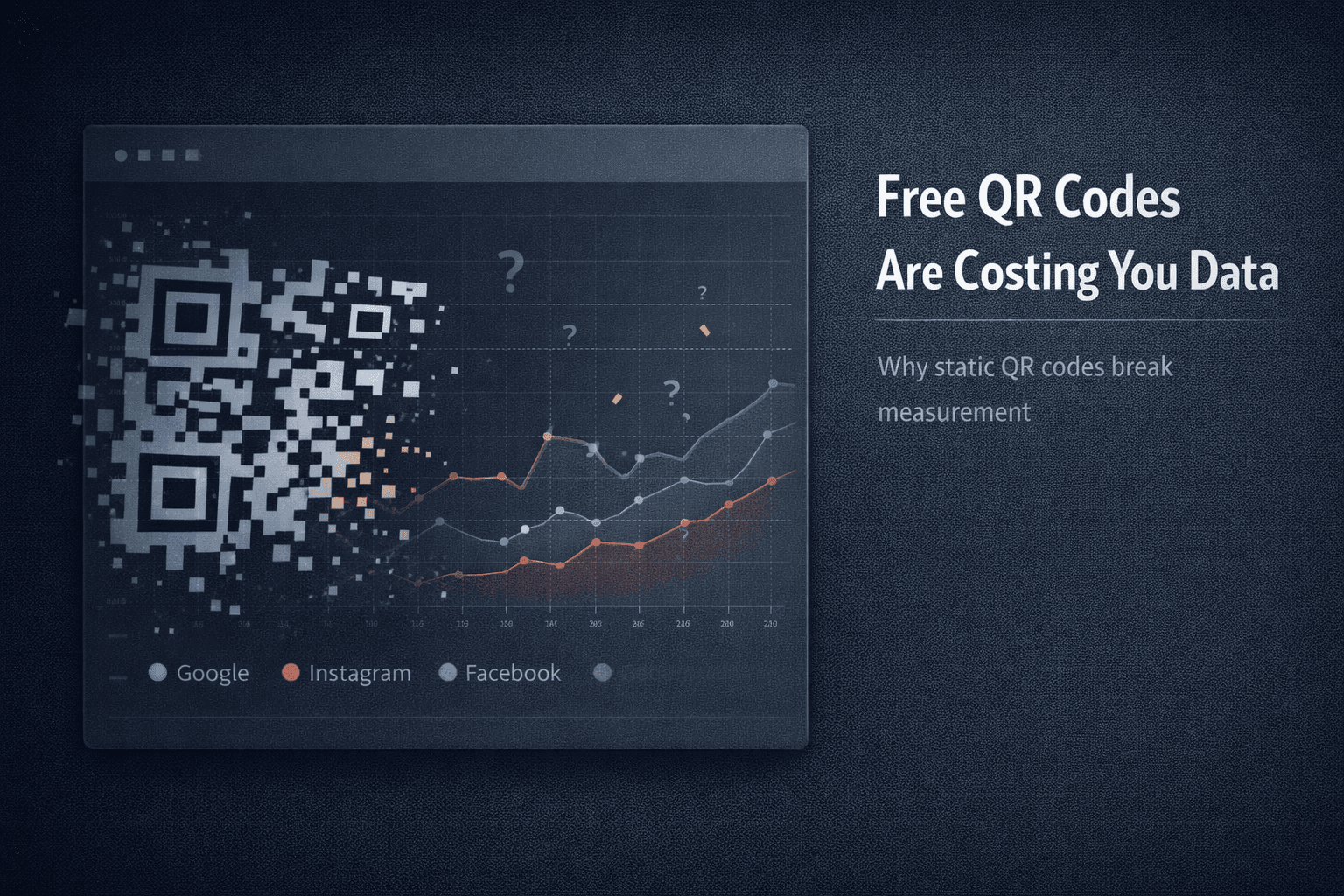
Free QR code generators look harmless.
You paste a URL.
You download an image.
You print it everywhere.
Then months later, you realize something uncomfortable:
You have no idea what worked.
No attribution.
No optimization.
No recovery if something breaks.
This isn’t a feature gap.
It’s a data loss problem—and it compounds over time.
What Free QR Code Tools Actually Give You
Most free QR generators provide exactly one thing:
A static image pointing directly to a URL.
That’s it.
No analytics layer.
No update path.
No campaign context.
No failure visibility.
Once printed, the QR code is frozen forever.
The Hidden Cost of Static QR Codes
Static QR codes fail silently.
Here’s what you lose:
- You can’t change destinations if a page breaks
- You can’t compare placements or locations
- You can’t detect low-quality or preview scans
- You can’t separate curiosity from intent
- You can’t recover from mistakes without reprinting
The cost isn’t obvious at first—but it grows with every campaign.
“We’ll Just Use Google Analytics” (Why That Fails)
This is the most common assumption—and it’s wrong.
Google Analytics:
- Tracks page views, not scans
- Misses users blocked by scripts or slow loads
- Can’t distinguish QR scans from other traffic
- Breaks attribution across offline touchpoints
By the time GA sees anything, the context is already gone.
Offline traffic needs pre-landing measurement, not page analytics.
Why Free Tools Can’t Be “Upgraded Later”
Teams often think:
“We’ll start free and upgrade once it works.”
That logic fails because:
- You can’t add tracking to QR codes already printed
- You can’t retroactively assign placement data
- You can’t recover lost scan history
- You can’t isolate which material performed best
By the time you upgrade, the data is already gone.
What Paid QR Infrastructure Actually Fixes
Paid QR systems don’t just add features—they change the architecture.
They introduce:
- A trackable link layer before redirection
- Dynamic destinations that can be updated anytime
- Placement-level analytics
- Separation between previews, bots, and real users
- Long-term data continuity
This turns QR codes from decoration into infrastructure.
The Real Risk: Scaling Blind
Free QR codes work fine—until you scale.
At scale:
- Printing costs rise
- Distribution expands
- Campaign decisions multiply
Without data, scaling doesn’t amplify success—it amplifies mistakes.
You don’t know what to repeat.
You don’t know what to stop.
You don’t know what to fix.
Where ZipZy Fits
ZipZy generates QR codes backed by trackable, branded short links, not static URLs.
This allows you to:
- Update destinations without reprinting
- Track scans before landing pages load
- Compare placements and campaigns
- Maintain consistent data across time
- Avoid shared-domain reputation risk
Free tools generate images.
ZipZy provides measurement and control.
A Simple Reality Check
Ask yourself one question:
If a QR code stops converting tomorrow, would I know why?
If the answer is no, the QR code is already costing you data.
Free QR code generators don’t fail loudly.
They fail quietly.
They don’t break campaigns—they make them unmeasurable.
If QR codes matter to your business, they deserve real infrastructure—not throwaway images.