Bitly vs Branded Short Links: Why One Gets Blocked and the Other Doesn’t
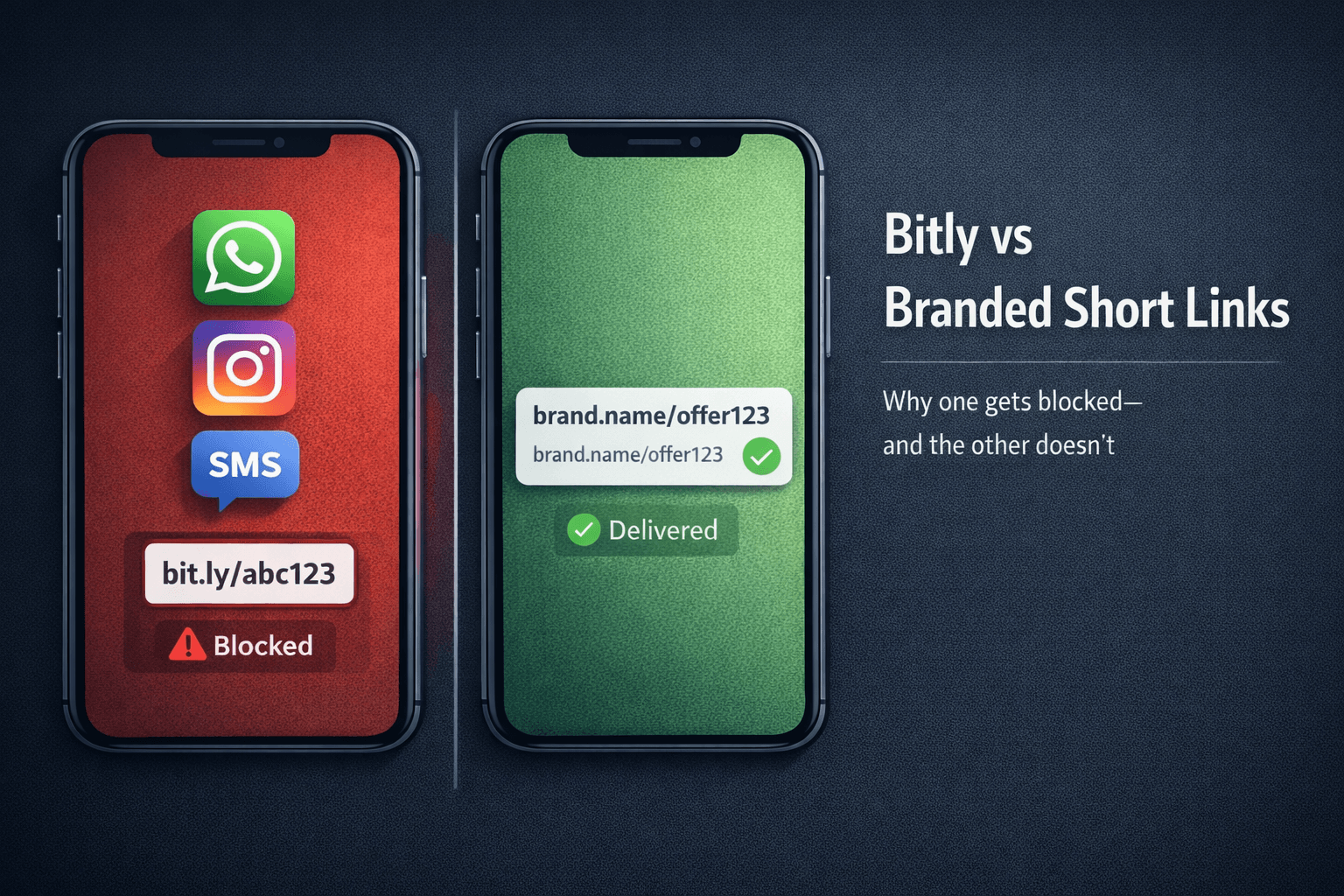
If you’ve ever had a short link blocked on WhatsApp, Instagram, or SMS, the usual reaction is to switch destinations, rewrite copy, or resend the campaign.
That rarely works.
In most cases, the problem isn’t the message or the landing page—it’s the domain behind the short link. And that’s where the difference between Bitly-style shared links and branded short links becomes critical.
This article breaks down exactly why shared short links get blocked and why branded links continue to deliver reliably.
The Core Difference (Not Features, Not Pricing)
Bitly and similar services are built on shared domains.
Branded short links are built on owned domains.
Everything else—analytics, dashboards, QR codes—is secondary.
Platforms don’t evaluate tools.
They evaluate domains.
How Platforms See a Bitly Link
When WhatsApp, Instagram, or an SMS carrier sees a Bitly link, it does not see you.
It sees:
- A public domain used by millions of senders
- Mixed-quality traffic (legitimate + abusive)
- Historical spam, phishing, and scam reports
- High-volume redirect activity
From a platform’s perspective, this is high-risk by default.
Even if your use is clean, you inherit:
- Abuse history from other users
- Domain-level penalties you cannot control
- Blacklists triggered by campaigns you didn’t run
Once the reputation drops, every Bitly link is scrutinized more aggressively.
Why Bitly Links Get Blocked So Often
Shared short-link domains fail for structural reasons:
-
Reputation is collective
One bad actor damages the domain for everyone. -
No isolation
Platforms do not separate “good” and “bad” users on the same domain. -
Permanent penalties
Once flagged, recovery is slow or impossible. -
Redirect opacity
Multiple hops obscure destinations, raising suspicion.
This is why Bitly links often:
- Show “unsafe link” warnings
- Work one day and fail the next
- Deliver on email but fail on WhatsApp or SMS
It’s not random. It’s inherited risk.
How Platforms See Branded Short Links
A branded short link uses a domain you own and control.
From a platform’s perspective, this changes everything:
- Reputation is tied only to your behavior
- Redirect patterns are consistent and predictable
- Abuse signals are isolated
- Trust can be built and maintained over time
If something goes wrong, you can:
- Pause links
- Change destinations
- Adjust redirect behavior
- Recover reputation
That control simply does not exist on shared domains.
Side-by-Side Reality Check
| Factor | Bitly / Shared Domains | Branded Short Links |
|---|---|---|
| Domain ownership | Shared | Yours |
| Reputation control | None | Full |
| Abuse inheritance | Guaranteed | None |
| Block recovery | Unpredictable | Possible |
| Platform trust | Low | High |
| Long-term reliability | Poor | Strong |
This is not a feature comparison.
It’s a risk model comparison.
Why Many Teams Switch Too Late
Most teams switch after:
- Campaigns fail
- Accounts get restricted
- Deliverability drops across channels
At that point, the damage has already spread.
The smarter move is switching before reputation collapses—when links still work but signals are degrading.
Where ZipZy Fits in This Comparison
ZipZy is designed around branded short links by default, not as an add-on.
It gives you:
- Branded domains under your exclusive control
- Clean, direct redirects with no unnecessary hops
- Visibility into link activity and delivery behavior
- Isolation from shared-domain abuse entirely
You’re not competing with other senders for trust.
Your domain stands on its own.
How to Prove This to Yourself (1-Minute Test)
You don’t need to migrate everything to see the difference.
- Take a link that was blocked or unstable on Bitly
- Create the same short link using a branded domain in ZipZy
- Share it in the same channel (WhatsApp, Instagram, or SMS)
If the branded link delivers normally while the Bitly link fails, you’ve confirmed the real cause: shared-domain reputation.
No campaigns need to be sent.
No users need to be contacted.
You’re isolating the variable platforms actually care about.
Bitly doesn’t fail because it’s a bad tool.
It fails because shared domains are no longer trusted infrastructure.
Branded short links work because they remove shared risk entirely.
If deliverability matters to your business, this isn’t an optimization choice—it’s a structural one.